LEED Certification: An International Standard

- What is a LEED Certification?
- How to obtain a LEED Certification?
- What are the Benefits of Pursuing LEED Certification?
- LEED vs. HQE: What are the Differences?
- LEED Certification and Wattsense Solution: A Powerful Combination
- Optimize Building Management with Wattsense
- How Wattsense Accelerates LEED Compliance
- Steps to Start Your LEED Journey with IoT
The proliferation of environmental certifications and labels in the construction industry worldwide is due to the growing awareness of ecological issues in real estate. Emerging as early as the 1990s, these quality marks from various countries merit pushing builders and building managers to consider the impact of their properties on climate and pollution. Among the labels recognized today for their seriousness and effectiveness, LEED certification is widely prevalent worldwide.
What is a LEED Certification?
LEED (Leadership in Energy and Environmental Design) represents a set of construction standards focused on sustainability. This certification applies to both new buildings and renovations. It encourages efficient energy management, the use of sustainable materials, and optimized water consumption.
The main objective of LEED is to reduce the environmental impact of buildings, notably by minimizing carbon emissions and optimizing energy efficiency.
A certification born in the United States
Initiated in the United States in 1998 under the auspices of the US Green Building Council, a non-profit American organization, LEED certification quickly gained popularity internationally.
It is particularly favored in North America but is expanding to Asia and Europe. In France, the French HQE (High Environmental Quality) label remains the most prevalent. However, LEED certification is starting to gain ground in the Paris region, especially in large real estate projects. To date, over 100,000 projects worldwide have obtained the LEED certification.
How to obtain a LEED Certification?
Obtaining LEED certification, like most recognized labels, is a demanding process that requires preparation and takes some time.
Everything Starts with Registration
The first step to obtaining LEED certification is project registration. It is highly recommended to engage with a specialized and accredited LEED Assistant Project Manager (APM). This professional plays an essential role, in guiding owners and developers through all necessary steps to obtain certification.
Before being admitted to engage in the certification process, it is necessary to:
- Conduct a LEED feasibility study.
- Have a construction or renovation project compatible with LEED requirements.
- Develop the LEED submission file for different project phases.
- Establish a low-impact environmental site management plan.
A Multidimensional Certification
Similar to the BREEAM certification the LEED certification addresses various aspects of a building. It considers eight distinct categories:
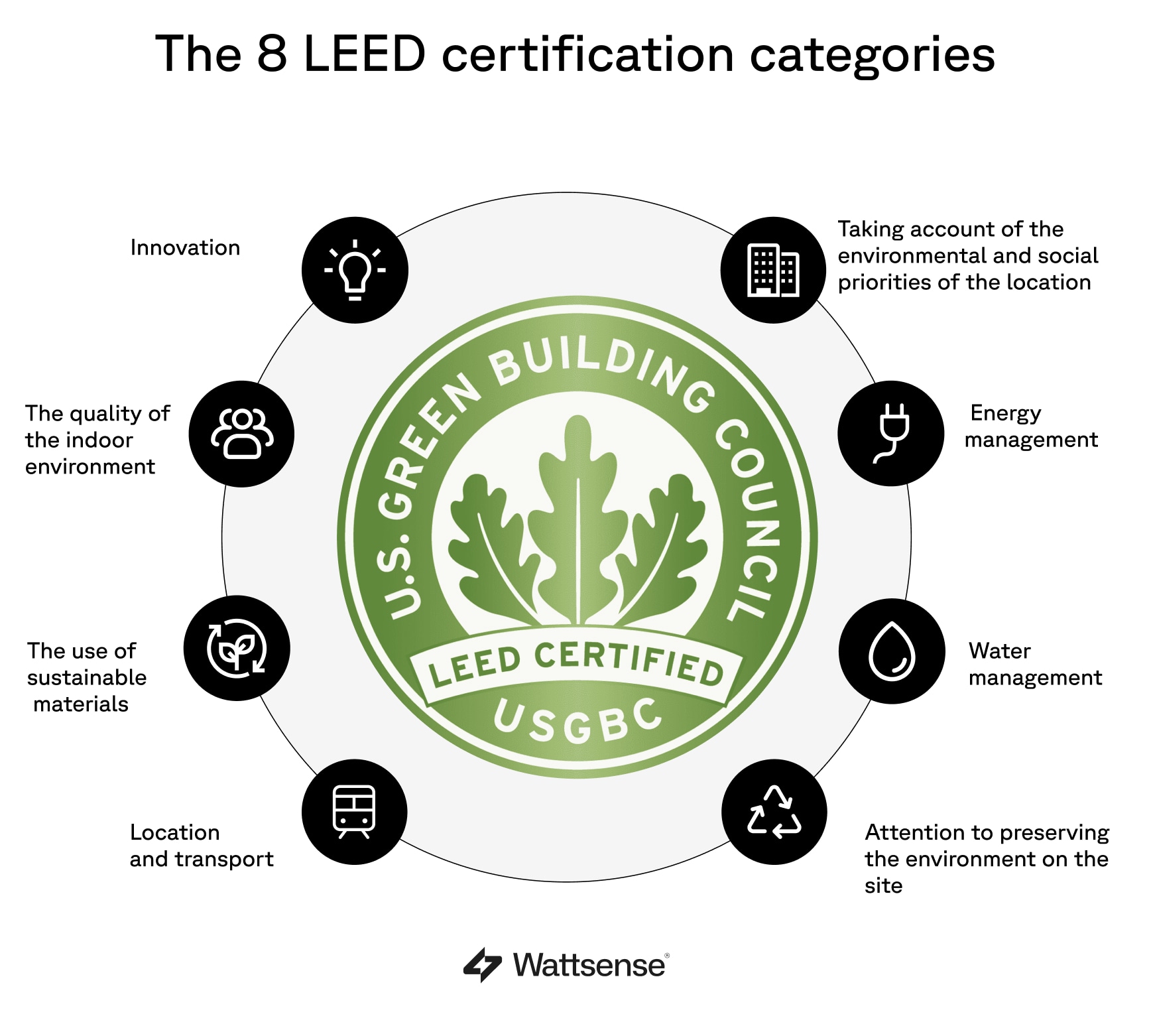
1. Site selection: This involves choosing the precise site for building construction and preserving, or even restoring, existing natural habitats and wildlife.
2. Location and transportation: Travel has a significant impact on CO2 emissions and climate change. Proximity to existing public transportation and encouragement of sustainable mobility modes are assets.
3. Water management: The building's design and use should minimize water consumption, harvest rainwater, and optimize wastewater recycling.
4. Energy management: Energy efficiency is at the heart of LEED certification. Implementation of passive design strategies based on climatic conditions, use of renewable energies, and establishment of control systems are important for LEED certification.
5. Indoor environmental quality: Continuous monitoring of indoor air quality and effective ventilation are factors considered in the LEED framework.
6. Materials: The use of durable, local, bio-sourced, and low environmental impact materials is encouraged. For example, FSC-certified wood, a framework for efficient material use, etc.
7. Innovation: This category rewards innovative approaches and creative solutions that go beyond standard certification requirements.
8. Local and regional priorities: This encourages real estate projects to consider the environmental, social, and health priorities of the project's location.
Four Levels of LEED Certification
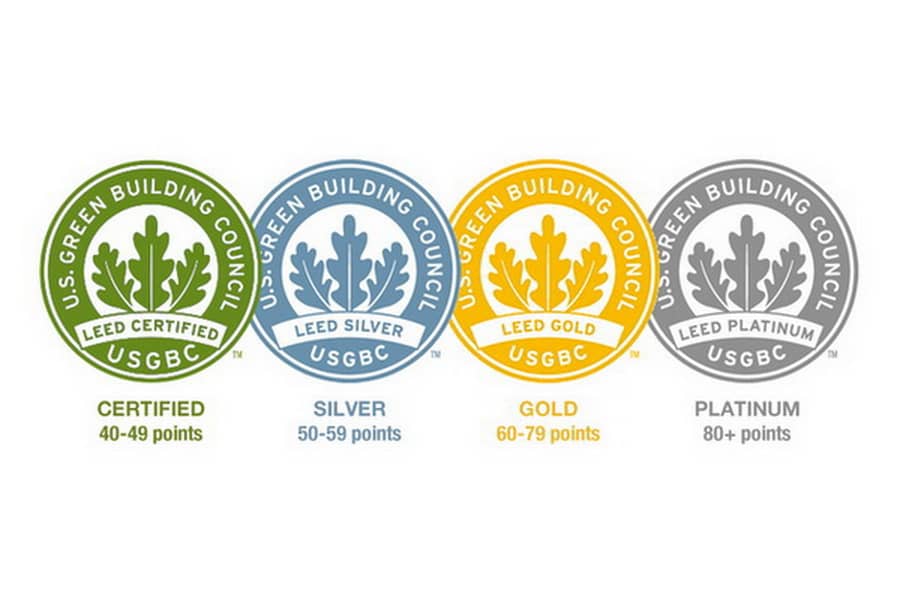
For each of the eight categories studied, a score is assigned to the project, resulting in an overall score out of 100. A minimum of 40 points out of 100 is required for a building to be LEED-certified.
Specifically, there are four levels:
- The base level, "LEED Certified," from 40 to 49 points,
- Silver level, from 50 to 59 points,
- Gold level, from 60 to 79 points,
- Platinum level, starting from 80 points.
LEED Certification: How Much Does It Cost?
Several factors can influence the cost of LEED certification: the larger the building, the more complex its construction and management, the more points need to be verified, and the higher the cost. Similarly, the cost varies depending on the level of certification sought.
On average, the cost of LEED certification is estimated at €6,000 to €7,500 for 10,000 square meters.
What are the Benefits of Pursuing LEED Certification?
LEED certification, besides being a recognized sustainability label, offers multiple advantages for owners, occupants, and the environment.
Increased Property Value
LEED-certified buildings enjoy significant appreciation in the real estate market. Certification is indeed a guarantee of quality and sustainability, two values emphasized today. Moreover, with increasingly stringent environmental regulations and expected developments in the coming years, a LEED-certified building ensures compliance with regulatory standards. All of this contributes to making the building attractive.
Substantial Savings on Energy Performance
A LEED-certified building offers numerous benefits in terms of management and occupancy. Thanks to well-thought-out design and the use of advanced technologies, it experiences a considerable reduction in energy and water consumption compared to a standard building. Additionally, materials used in LEED constructions are often recycled and locally sourced, thus reducing the project's carbon footprint. The comfort and health of occupants are also improved due to better indoor air quality.
To read: How to Reduce Energy Consumption in Buildings?

A Positive Impact on the Environment and Society
LEED certification goes beyond the technical aspect of construction. It also encompasses a commitment to society and the environment. A sustainable LEED building helps reduce greenhouse gas emissions, preserve natural resources, and improve urban biodiversity. Moreover, these projects promote the development of environmental awareness by educating and raising awareness among occupants and, more broadly, people residing nearby about sustainable development issues.
LEED vs. HQE: What are the Differences?
LEED certification and the HQE label (High Environmental Quality) are two major references in the field of sustainable construction, one American and the other French. Designed with many common goals, these two labels still have some differences.
Many Common Points
LEED and HQE converge on several fundamental aspects. Both certifications aim to improve the energy performance of buildings, reduce their carbon footprint, and promote the use of ecological materials. They also encourage the improvement of indoor air quality and occupant comfort. These certifications are reference tools for construction projects aspiring to reduce environmental impact and achieve optimal energy efficiency.
Key Differences Between HQE and LEED
The "pluses" of LEED certification
LEED certification is a little more environmentally oriented than HQE:
- Special attention to the building site.
- Focus on construction and decoration materials.
- Slightly more demanding criteria in terms of energy.
The "pluses" of HQE certification:
The HQE label emphasizes certain elements that are absent or less important in LEED certification:
- Occupant well-being.
- Acoustic comfort.
- Visual comfort (lighting, etc.).
- Sanitary quality of spaces and water.
LEED Certification and Wattsense Solution: A Powerful Combination
Integrating smart solutions like those offered by Wattsense can help obtain LEED certification for buildings.
Optimize Building Management with Wattsense
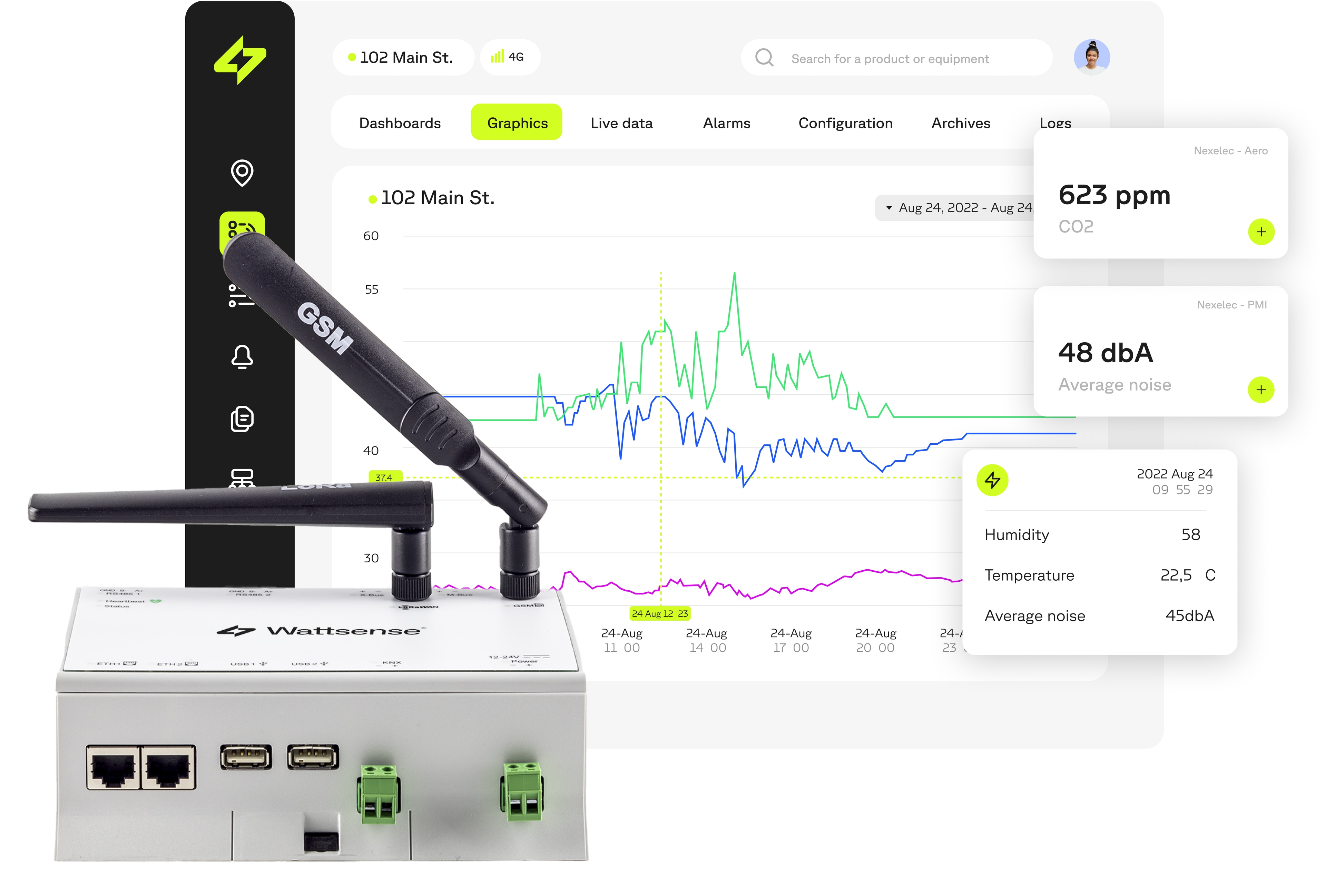
Wattsense is a technological solution that enables efficient management of buildings in terms of energy and resources. By connecting to all the technical equipment and IoT sensors in your buildings, Wattsense provides access to precise, real-time data on energy consumption, CO2 emissions, and other environmental parameters. You can thus monitor all building consumptions on a console that centralizes all information and manages resources flexibly and economically.
With Wattsense, many prerequisites are already in place to obtain LEED certification
Economical and Ecological Resource Management
Wattsense plays a vital role in economic resource management, a central element allowing buildings to meet LEED certification criteria related to water and energy management. Our solution is the ideal tool for controlling and implementing water, gas, and electricity consumption strategies. By centralizing all data, it provides an overview of consumption over time and where to take action. Advanced features like alarms in the Wattsense Tower allow quick detection of potential overconsumption or equipment failure.
Wattsense Improves Occupant Comfort
Wattsense helps significantly improve occupant comfort while enabling rational and therefore economical consumption. Our solution, combined with sensors, gives you access to all the necessary data and features to have precise control over lighting, acoustics, and room temperature. No more unnecessarily heated empty rooms or undetected water leaks. Optimized management of these factors results in a better quality of life in work and living spaces.
Continuous Control of Water and Air Sanitation
Wattsense's centralization of technical equipment data also ensures continuous control of air and water quality, guaranteeing a healthy environment for occupants. This control is vital to meet the strict requirements of LEED certification for indoor environmental quality.
Therefore, Wattsense is an excellent partner for companies seeking LEED certification for their buildings. By centralizing and efficiently managing building environmental data, and by connecting its solution with over 1 500 pieces of equipment, Wattsense enables optimized management of energy, and water, and actively contributes to occupant well-being.
How Wattsense Accelerates LEED Compliance
Wattsense provides the technology to simplify building management and bridge the gap between physical assets and digital certification. We remove the technical barriers that often stall green building projects.
Our solution is designed to collect and centralize data from any building, regardless of age or equipment type. By providing an open, interoperable platform, we help you improve building performance and cut operational costs while earning LEED credits.
Breaking Silos: Interoperability with BACnet, Modbus, and M-Bus
The core of the Wattsense solution is its ability to speak every major building protocol. Our IoT Gateway acts as a universal translator, unifying data from diverse sources into a single stream.
- BACnet: Connect easily to modern HVAC and lighting controllers.
- Modbus: Extract data from electrical meters, boilers, and heavy machinery.
- M-Bus: Retrieve precise consumption data from heat and water meters.
By breaking these silos, Wattsense provides the centralized visibility required to satisfy the most demanding LEED energy monitoring requirements.
Deploying LoRaWAN Sensors for IEQ and Environmental Monitoring
Running new cables in an existing building is expensive and disruptive. Wattsense solves this by integrating LoRaWAN technology. These wireless, battery-powered sensors can be placed anywhere in minutes.
You can deploy LoRaWAN sensors to monitor CO2, temperature, and occupancy throughout your facility. The Wattsense gateway collects this wireless data and makes it available to your management tools, helping you earn valuable IEQ credits without invasive construction.
Wattsense Bridge: Local Data Acquisition for Automation
The Wattsense Bridge is our foundational solution for local data acquisition and on-site supervision. It is the most innovative open, interoperable gateway for connecting your building equipment to a BMS or other local tools.
With remote configuration and real-time data access, the Bridge is ideal for projects that require a reliable local bridge for sensor data. It allows for local automation based on real-time conditions, ensuring your building stays within the optimal parameters for LEED compliance.
Tower Lift: Cloud Connectivity for Energy Management Platforms
For portfolios that need to push data to the cloud for deep analysis, Tower Lift is the perfect solution. It focuses purely on efficient and secure data retrieval, providing powerful cloud connectivity for PropTechs and energy managers.
Tower Lift features robust data historisation and MQTT / API integration. This allows you to push building data—from electricity meters to environmental sensors—directly to your preferred energy management platform for long-term LEED performance tracking and reporting.
Tower Control: Optimizing Performance in Small to Medium Buildings
Tower Control is our "Light BMS" designed specifically for small and medium-sized buildings. It provides a full suite of tools for monitoring, controlling, and optimizing building performance from a single interface.
- Automation Scenarios: Create rules to optimize energy consumption automatically.
- Scheduling: Ensure HVAC and lighting only run when the building is occupied.
- Remote Alarms: Receive instant notifications for critical events that could impact your green score.
- Dashboards: Visualize building performance with customizable insights through intuitive graphs.
Steps to Start Your LEED Journey with IoT
Transitioning toward a sustainable model should be an iterative process. You don't need a total system overhaul to begin earning points. By focusing on data collection and connectivity today, you build the foundation for certification tomorrow.
- Perform a Technical Audit: Identify your existing systems and protocols (BACnet, Modbus, etc.) to understand your current data accessibility.
- Unify Your Connectivity: Deploy a Wattsense gateway to bridge the gap between your legacy equipment and your management software.
- Deploy Targeted Sensors: Use LoRaWAN to fill in the gaps for IEQ and occupancy data where wiring is not feasible.
- Monitor and Historize: Use Tower Lift to begin building a database of your energy and water consumption.
- Optimize and Automate: Use Tower Control to implement energy-saving scenarios and schedules that directly contribute to your LEED score.
By centralizing your data and simplifying your management, Wattsense helps you turn your property into a high-performing, certified Smart Building. Discover how our solutions can help you achieve your sustainability goals and increase the value of your assets today.
Want to learn more about the Wattsense connectivity solution?
Discover our solution