What is Building Automation?
Building automation is the process of integrating automation and control technologies and systems to centrally monitor and control building management systems, including heating, ventilation, air conditioning, lighting and security.
The aim is to improve energy efficiency, occupant comfort and maintenance while reducing operating costs and complying with various regulations, such as the BACS decree.
Thanks to automation, buildings can operate more intelligently and efficiently, adapting to changing needs and environmental conditions in real-time.
Today, thanks to advances in new technologies, particularly the IoT (Internet of Things), building automation has become accessible to structures of all sizes, at an affordable cost. The IoT offers the possibility of deploying or modernising a Building Management System (BMS) quickly and easily, No matter the type or size of the building.
This makes it possible to modernise a building without major work, complexity or expense, paving the way for more efficient and sustainable infrastructure management.
This advance means that small and medium-sized businesses can take advantage of the benefits of building automation while complying with regulations, thanks to solutions like Wattsense that are tailored to their constraints.
The simple solution for automating buildings
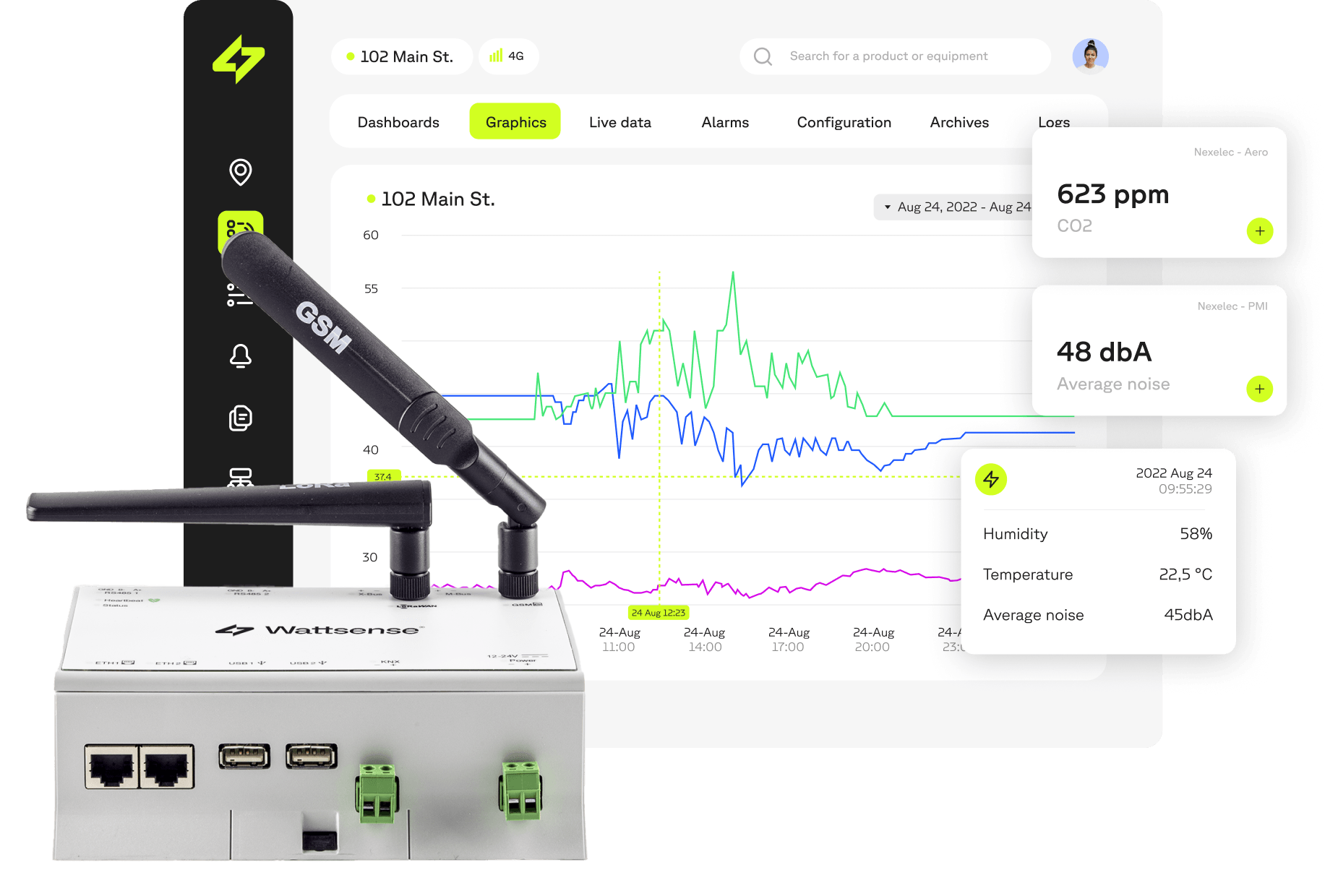
Our Tower Control solution lets you monitor and control a building's technical systems remotely and centrally. All without major renovation, equipment changes or additional complexity.
The Difference Between BAS, BMS, and Building Control Systems
The terminology in the industry can often be confusing. While often used interchangeably, there are subtle differences between a building automation system, a Building Management System (BMS), and broader building control systems:
- BAS: Usually focuses on the automated logic of mechanical and electrical systems like HVAC and lighting.
- BMS: Often a broader term that includes security, fire safety, and lift management alongside automation.
- Building Control Systems: A generic term referring to any hardware or software used to regulate building equipment.
Despite these semantic differences, the modern trend is towards a unified "Light BMS" or IoT-driven platform that handles all these functions through high-level interoperability.
Core Components: Sensors, Controllers, and Output Devices
To function effectively, building automation systems rely on a three-tier architecture of building automation controls. These components work in a constant feedback loop to maintain the desired environment:
- Sensors: These are the eyes and ears of the system. They measure temperature, humidity, (CO_2) levels, and occupancy throughout the facility.
- Controllers: These are the decision-makers. They receive data from sensors and apply pre-defined logic to determine if a change is needed.
- Output Devices: Also known as actuators, these are the hands of the system. They physically move valves, start fans, or dim lights based on commands from the controller.
The main automated processes in buildings
Many procedures can be automated. Among the most common are
- Intelligent lighting management: daylight sensors can be used to maximise natural light levels, reducing lighting costs.
- Automated ventilation: ventilation is regulated to maintain an acceptable level of humidity, often between 40 and 60%.
- Temperature adjustment: to a set temperature (19 degrees in offices, for example);
- Preventive maintenance systems.
- Security systems: access management, fire alarms, etc.
The Technical Infrastructure of Building Automation Controls
The efficacy of building automation controls depends entirely on the communication network supporting them. Traditionally, these networks were proprietary and closed, making it difficult for devices from different manufacturers to "talk" to one another.
Modern building automation has moved towards open standards. This shift has unlocked the potential for much more complex and efficient control strategies, allowing integrators to mix and match the best hardware for each specific application.
Standard Communication Protocols (BACnet, Modbus, M-Bus)
The backbone of any building automation system is the communication protocol. These are the standardised languages that allow different components to exchange information without conflict:
- BACnet: The most common protocol in the industry, designed specifically for building automation and control networks.
- Modbus: A robust and simple protocol frequently used for power meters, boilers, and industrial-grade equipment.
- M-Bus: The European standard for the remote reading of utility meters, essential for tracking heat, water, and gas consumption.
Integrating Wireless IoT Protocols (LoRaWAN)
The rise of the Internet of Things (IoT) has introduced wireless protocols like LoRaWAN into the world of building automation. LoRaWAN is a long-range, low-power wireless protocol that is revolutionising how we collect data in existing buildings.
Because it does not require expensive cabling, LoRaWAN is the ideal solution for retrofitting sensors into older structures. It allows facility managers to add occupancy sensors or air quality monitors in minutes, providing the granular data needed for advanced building control systems without invasive construction.
The Shift from Legacy Systems to IP and MQTT
We are currently witnessing a massive shift away from old-fashioned serial connections towards IP-based networking. Using an IoT Gateway, buildings can now push data directly to the cloud or local supervisors using MQTT.
MQTT is a lightweight messaging protocol that is perfect for building automation because it requires very little bandwidth. This allows for the high-speed transmission of data from thousands of sensors, ensuring that the building automation systems always have the most up-to-date information to make decisions.
The benefits of building automation
As well as simplifying building management procedures, which is a major advantage, building automation offers a number of other benefits.
- Energy efficiency: once a certain temperature is reached, the heating system in a room will go on standby or, conversely, will start up automatically. The same can apply to the lighting in an office or communal area, depending on whether or not there are occupants. If everything is set up properly beforehand, energy savings in a building can be as much as 30%.
- Greater comfort for occupants: ideal temperature throughout the day, blinds closed or raised depending on light levels, regulation of air quality and humidity - all these elements contribute to the well-being of occupants.
- Automated building security: video protection, fire alarms, air quality, and access management for each employee. Automating these tasks on a premises-by-premises basis enhances overall security.
- Automation also enables a predictive and preventive maintenance system, reducing maintenance costs.
Challenges in Traditional Building Automation
Despite the clear benefits, traditional building automation has often been plagued by high costs and technical complexity. Many legacy systems are "closed", meaning they only work with equipment from the same brand, leading to vendor lock-in.
Interoperability Issues and Siloed Data
The "Tower of Babel" problem is common in many buildings. A chiller might speak BACnet, a meter might use Modbus, and new sensors might use LoRaWAN. Without a universal way to unify these signals, the data remains siloed and unusable. This lack of interoperability is the biggest barrier to creating a truly smart building.
Complexity of Installation and Configuration
Traditional building control systems are notoriously slow to install. They require extensive manual programming and on-site commissioning. To solve this, the industry has moved towards "Plug & Play" solutions that can be configured remotely, lowering the barrier to entry for professional building automation.
Wattsense: The Simple Solution for Automating Buildings
Wattsense provides the technology to simplify building management. We remove the technical barriers that prevent buildings from being connected and optimised.
The Bridge: Universal Gateway for Local Integrators
The Wattsense Bridge is the most innovative open, interoperable IoT Gateway on the market. It is the foundational solution for connecting your building equipment to a Building Management System (BMS) or other on-site supervision tools.
- Local Redirection: Easily integrate with BACnet, Modbus, or MQTT for local control.
- Use Case: Ideal for projects requiring a reliable, local bridge for sensor data (e.g., LoRaWAN) to be integrated into an existing BMS.
Tower Lift: Cloud Data Access for PropTechs
Tower Lift is our IoT solution designed for those who want to leverage building data without needing direct automation. It focuses purely on efficient and secure data retrieval.
- Data Historisation: Store and access historical data for in-depth performance analysis.
- API & Webhook Integration: Seamlessly push data to your preferred cloud platforms via API.
Tower Control: A Light BMS for Complete Automation
Tower Control is our flagship offering, providing a full suite of tools for monitoring, controlling, and optimising building performance.
- Automation Scenarios: Create custom rules to optimise energy efficiency and comfort automatically.
- Scheduling: Implement time-based controls for HVAC and other systems.
- Remote Alarms: Receive instant notifications for critical maintenance events.
Future-Proofing your Smart Building strategy
The future of building automation is open and scalable. By choosing an interoperable solution like Wattsense, you future-proof your building. You gain the flexibility to add new sensors, switch cloud platforms, or adjust automation logic as your needs change.
In conclusion, building automation is the key to managing modern properties effectively. By centralising your data and simplifying your connectivity, Wattsense helps you turn any facility into a high-performing, energy-efficient smart building.