LoRaWAN Protocol: Everything You Need to Know

- What is LoRaWAN?
- How does LoRaWAN work?
- Advantages and Disadvantages of LoRaWAN
- LoRaWAN: Highly Suitable for Technical Management and Building Performance
- Key Benefits of LoRaWAN for Facility Managers and Property Owners
- Top LoRaWAN IoT Use Cases in Building Management
- The Challenge: Integrating LoRaWAN into Legacy BMS
LoRaWAN (Long Range Wide Area Network) is currently at the forefront of innovation in the Internet of Things (IoT) domain, especially for building-related applications. This network protocol stands out for its low energy consumption and extended range, two major advantages that significantly enhance the performance of IoT devices.
In a world where connectivity and energy efficiency are paramount, LoRaWAN offers an optimal solution for a multitude of IoT scenarios, ranging from environmental monitoring to intelligent building management. This article delves into the technical details and practical applications of LoRaWAN, providing an in-depth understanding of this protocol and its impact on today's connected world.
If you want to understand in more detail what this protocol entails and what its specifications are, you'll find all the information you need in this article!
The Wattsense Solution makes integrating LoRaWAN technology into buildings simple, fast, and affordable. Feel free to request your demonstration to learn more.
What is LoRaWAN?

LoRaWAN is a Low Power, Wide Area Network (LPWAN) protocol designed to wirelessly connect battery-operated IoT devices to regional, national, or global networks.
The LoRaWAN protocol was developed in 2009 by the founders of the Grenoble-based company Cycléo, which was acquired by Semtech in 2012. Three years later, Semtech founded the LoRa Alliance.
The LoRa Alliance
The LoRa Alliance is an industry association that now has over 500 members, including IoT product and service providers, manufacturers, and telecommunications companies. The LoRa Alliance is a major player in the IoT ecosystem, significantly contributing to the growth and adoption of LoRaWAN technology worldwide. It organizes events, provides training, manages a certification program, and actively develops the LoRaWAN ecosystem for various IoT applications, from urban management to agriculture.
Read: LoRa vs LoRaWAN: What are the Differences?
How does LoRaWAN work?
Signal Range
LoRaWAN is known for its ability to provide long-distance communication, often far beyond that of traditional wireless networks. This extended range makes it ideal for applications in extensive areas, including rural or urban areas, with the ability to cover kilometers.
A single LoRaWAN antenna can effectively cover a large area, ranging from 3000 to 5000 square meters, which is ideal for use in medium and large buildings. LoRaWAN technology ensures reliable communication with sensors placed on different floors, including areas that are typically hard to reach, such as basements.
Signal Adaptability and Spreading Factor
LoRaWAN also distinguishes itself by its ability to effectively adjust the signal power, thereby improving range while minimizing energy consumption. This efficiency is achieved through dynamic adjustment of the Spreading Factor (SF), which adapts according to the transmission environment conditions. This ensures efficient signal transmission, even through obstacles, while preserving the battery life of the sensors. This aspect of LoRaWAN is particularly beneficial for modernization projects in existing buildings where signal transmission can be challenging.
"Wattsense offers a private LoRaWAN solution, which allows being closer to LoRaWAN equipment, resulting in a lower spreading factor and thus improving their lifespan and reducing latency."
Read: Monitor building technical equipment using LoRaWAN: A solution to wiring issues.
Energy Consumption
LoRaWAN devices, designed for low energy consumption, offer up to 10 years of battery life, which is ideal for applications where frequent battery replacement is difficult or costly. On the market, a wide range of LoRaWAN sensors is available to monitor various parameters in buildings, such as temperature, humidity, and energy consumption. The LoRaWAN ecosystem includes three equipment classes, balancing energy consumption and continuous communication.
Class A sensors, for example, are highly energy-efficient, activating briefly for measurements and communications, and ideal for battery-dependent applications. Class C sensors, on the other hand, are in constant listening mode and consume more power, usually connected to an external power source.
Here are some use cases for Class A and C devices:
- Creating simple heating regulations using a thermostatic valve.
- Controlling ON/OFF relays using dry-contact sensors. In these examples, for reactive regulation or quick ON/OFF, you would use Class C devices.
Latency and Transmission
Usually, LoRaWAN latency is slightly higher compared to cellular networks but remains adequate for many IoT applications that do not require instant transmission. It is important to note that latency may vary slightly depending on the type of sensor used. For a Class C sensor, a command (downlink) is sent as soon as it is programmed, and there is no latency. With a Class A sensor, commands are sent in response to a message previously sent by the sensor to the server.
Data Rate
The data rate in LoRaWAN typically ranges from 0.3 kbps to 50 kbps. This range is suitable for transmitting small amounts of data, typical of IoT applications, where payload sizes range from 51 to 241 bytes.
Flexibility of LoRaWAN Network: Private or Public LoRaWAN Network
Advantages and Disadvantages of LoRaWAN
Advantages of LoRaWAN
Cost Savings
Reduced sensor and infrastructure costs. LoRaWAN gateways are economical and require fewer units compared to other wireless protocols.
Sensor Diversity
Proven and widely adopted technology, offering a wide range of sensors suitable for various IoT applications
Simplified Programming
Minimizes the need for complex programming, making implementation easier.
Wireless Solution
Eliminates issues related to wiring, ideal for renovations and installations in complex locations.
Low Power Consumption and Long Range
Ideal for IoT solutions requiring low power consumption and extensive coverage.
Network Flexibility
Compatible with both public and private networks, offering excellent signal penetration even in underground environments
Tracking and Geolocation
Allows for real-time tracking services without requiring GPS chips.
Disadvantages of LoRaWAN
Bidirectional Management
Complexities in programming and commissioning due to encoding, throughput, and latency in the case of Class A sensors.
Latency
Latency time can be significant depending on the type of sensor and may limit certain applications.
Limitation for Large Payloads
Less suitable for applications requiring high data throughput and does not support multimedia files.
LoRaWAN: Highly Suitable for Technical Management and Building Performance

LoRaWAN proves to be particularly effective for technical management and improving building performance. The use of IoT technologies communicating via LoRaWAN – such as sensors, equipment, and LoRaWAN gateways – is a great way to easily, quickly, and without heavy construction work integrate smart building technologies or modernize building technical management. In other words, thanks to LoRaWAN, it becomes simpler and more cost-effective to implement energy efficiency strategies, improve occupant comfort, and reduce maintenance costs, synergizing with other technologies.
A turnkey LoRaWAN solution
The Wattsense solution enables interoperability and the integration of IoT solutions with local building management systems and digital services.
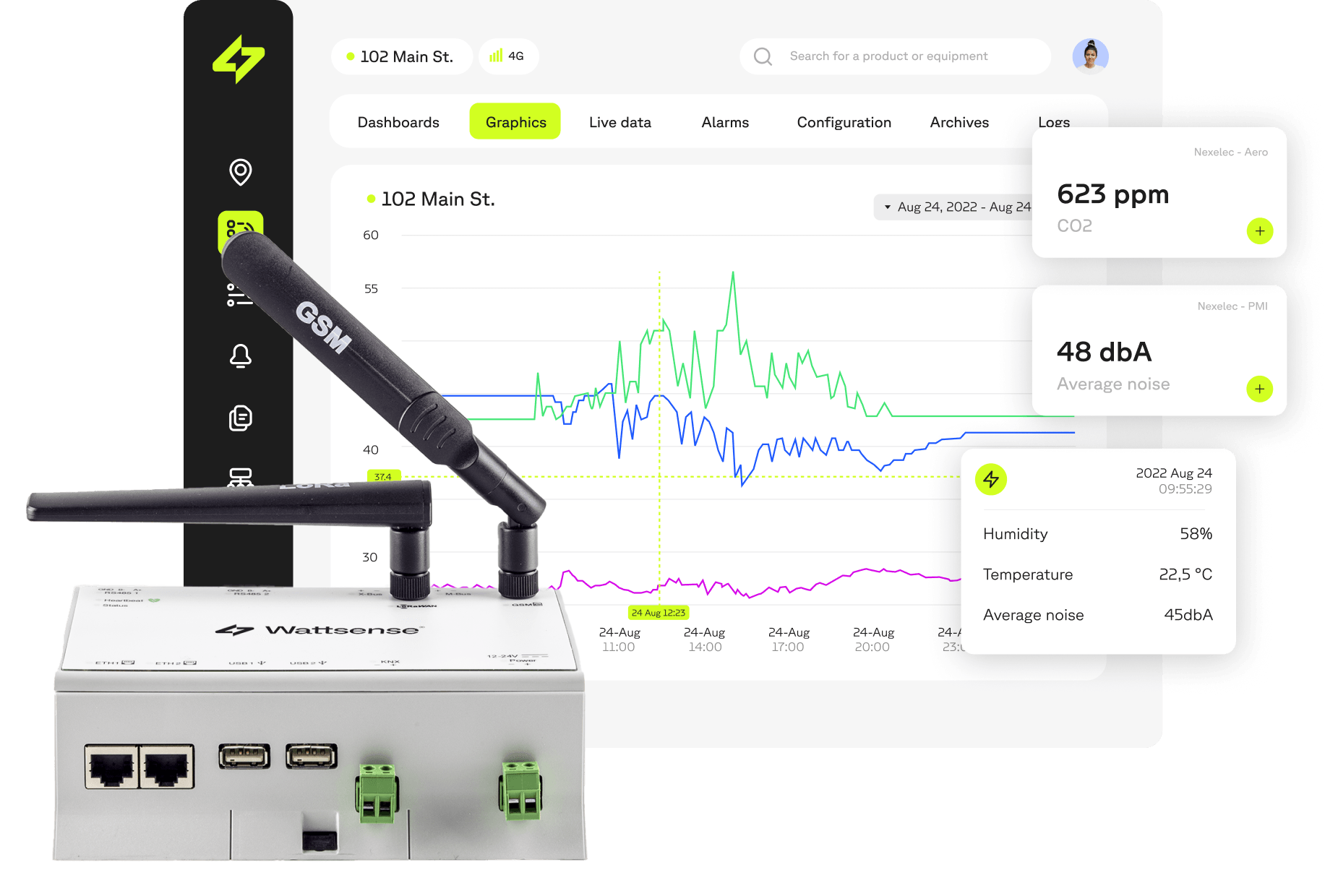
Wattsense's connectivity solution converts LoRaWAN data into BACnet IP/Modbus IP, allowing you to locally access data from any LoRaWAN sensor and deploy Smart Building solutions rapidly, with great flexibility.
Practical Applications of LoRaWAN in Buildings
- Energy Monitoring: Management and tracking of energy consumption via meters and individualization of heating costs.
- Cold Chain Monitoring: Crucial monitoring of temperatures in sensitive storage areas, such as refrigerators and cold rooms, to ensure proper preservation of temperature-sensitive products, essential in the food and health sectors.
- Air and Water Quality: Use of advanced sensors for continuous monitoring of CO2 levels and volatile organic compounds (VOCs), ensuring a healthy environment compliant with standards.
- Comfort: Temperature and humidity control for optimal indoor environment, contributing to a more pleasant working or living environment.
- Maintenance: Implementation of alarms and use of meters for remote reading, use of dry contacts for equipment fault recovery (AHUs, chillers, boilers, etc.). For example, it's possible to install LoRaWAN water leak detection sensors.
- Building Renovation: Seamless integration of modern equipment into existing Building Management Systems (BMS), allowing technological upgrades without complex wired installations to comply with various regulations such as the tertiary decree or the BACS decree. For example, installing actuators like dry contacts and communicating thermostatic valves.
- Security and Other Applications: Enhancement of security and other functionalities beyond pure technical management.
Read: LoRaWAN project best practices
Frequency Plans: Operating LoRaWAN in the UK (868 MHz)
One of the most significant advantages of lorawan iot is that it operates on unlicensed radio frequencies. This means property owners do not need to pay for cellular data plans or license specific bands to run their network.
In the UK and Europe, the standard frequency plan is the 868 MHz band. This sub-gigahertz frequency is what allows for the long range and deep indoor penetration that Wi-Fi or Bluetooth simply cannot match. Because it is an open standard promoted by the LoRa Alliance, a vast ecosystem of certified sensors is available for almost any building application.
Key Benefits of LoRaWAN for Facility Managers and Property Owners
For those responsible for a building management system, the adoption of lorawan iot offers immediate and measurable advantages. The technology was built from the ground up to solve the specific pain points of monitoring physical infrastructure where power sources and network cables are often unavailable.
By moving toward a wireless infrastructure, managers can achieve a level of granular visibility that was previously cost-prohibitive. This data-driven approach is the foundation of modern BMS connectivity and predictive maintenance strategies.
Deep Indoor Penetration: Connecting Basements and Plant Rooms
The most common failure point for wireless technology in a smart building is interference from the building's own structure. Steel beams, reinforced concrete, and underground plant rooms often act as shields that block Wi-Fi or cellular signals.
Lorawan iot uses a low-frequency radio signal that excels at penetrating dense materials. It can easily reach from a rooftop gateway down into a basement boiler room. This makes it the perfect solution for monitoring critical infrastructure located in hard-to-reach areas without the need for expensive signal repeaters.
Low Power Consumption: Long Battery Life for Maintenance Savings
Maintenance is a significant portion of any building's operational budget. If wireless sensors required battery changes every few months, the labor cost would negate any savings. Lorawan iot is specifically optimized for low power consumption.
- Sensors spend most of their time in a "sleep" mode.
- Data packets are tiny, requiring very little energy to transmit.
- Batteries can last between 5 to 10 years depending on the transmission interval.
This "set it and forget it" capability allows facility managers to deploy hundreds of sensors across a site with minimal ongoing maintenance requirements.
Cost-Efficiency: Reducing Cabling and Installation Time
The single biggest cost in any retrofit project is labor and cabling. Traditional wired systems require technicians to pull wires through walls, ceilings, and risers, often involving asbestos risks or structural drilling.
Lorawan iot eliminates these requirements. A sensor can be peel-and-stick mounted in minutes. Because the network utilizes a single IoT gateway to cover thousands of square meters, the infrastructure cost per data point is significantly lower than any other connectivity standard. This makes it the most viable option for improving the performance of existing buildings.
Top LoRaWAN IoT Use Cases in Building Management
The flexibility of lorawan iot has led to an explosion of diverse use cases. By integrating wireless sensors into their daily operations, managers can move from reactive to proactive management, identifying issues before they become expensive failures.
When these data points are integrated into a building management system, they provide the context needed to optimize energy use and occupant well-being. Here are the most common applications in today's smart building environment.
Indoor Air Quality (IAQ) and Comfort Monitoring
Post-pandemic, air quality has become a top priority for tenants. High levels of CO2 are directly linked to cognitive fatigue and poor productivity. Lorawan iot sensors can monitor:
- CO2 Levels: Triggering increased ventilation when rooms are crowded.
- Humidity: Preventing mold growth and protecting building fabric.
- VOCs: Monitoring for chemical pollutants in the air.
- Temperature: Ensuring thermal comfort while avoiding over-heating or over-cooling.
Energy Efficiency: Sub-metering and Water Leak Detection
True energy efficiency requires granular data. It is not enough to know how much electricity a building uses; you must know where it is being used. Lorawan iot pulse counters can be attached to existing "dumb" meters to turn them into smart meters instantly.
Furthermore, water leak detection is a major risk-mitigation use case. Wireless floor sensors can detect the presence of water in a plant room or under a sink and send an immediate alarm via the building management system, preventing thousands of pounds in water damage and insurance claims.
Occupancy Monitoring for Space Optimization
With the rise of hybrid work, many property owners are realizing that their space is underutilized. Under-desk or ceiling-mounted PIR sensors can track actual occupancy without compromising privacy (no cameras).
This data allows facility managers to:
- Identify "dead" zones that are being heated and cooled unnecessarily.
- Optimize cleaning schedules based on actual usage rather than fixed times.
- Right-size their real estate portfolio based on factual data rather than guesses.
The Challenge: Integrating LoRaWAN into Legacy BMS
While the benefits of lorawan iot are clear, the greatest hurdle remains interoperability. Most existing building management systems operate on legacy wired protocols such as BACnet or Modbus. These systems were designed decades ago and do not natively understand the modern wireless packets sent by LoRaWAN sensors.
This creates an "interoperability gap." Without a specialized IoT gateway to act as a translator, the valuable data collected by wireless sensors remains stuck in the cloud, unable to influence the local control logic of the building's boilers, chillers, and fans.
The Interoperability Gap: LoRaWAN to BACnet and Modbus
For a smart building to be truly efficient, its systems must talk to each other. For example, if a LoRaWAN sensor detects that a meeting room is empty, it should tell the BACnet controller to dim the lights and reduce the airflow.
Traditionally, this required complex software integrations and custom coding. The challenge is to convert the modern, web-friendly data of IoT into the robust, industrial-grade protocols used by traditional BMS connectivity. Solving this gap is essential for any successful building retrofit.
Security Concerns in IoT Data Collection
As buildings become more connected, security is a paramount concern. Lorawan iot is one of the most secure wireless standards available. It uses two layers of AES-128 encryption:
- Network Session Key: Ensures the authenticity of the node in the network.
- Application Session Key: Ensures the data is private and cannot be read by the network provider.
However, the risk often lies at the gateway level. When data is bridged from a wireless network to a local building network, the gateway must be robust enough to prevent it from becoming a backdoor for cyber-attacks.
In Conclusion
The LoRaWAN communication protocol is a long-range, low-power wireless protocol designed to connect objects to the Internet, such as IoT sensors in environments where traditional cellular connectivity is not possible or costly. It's an efficient and sustainable solution for Smart Buildings due to its longevity and cost-effectiveness and can improve energy performance, comfort, air quality, security, or equipment management of a building.
Want to learn more about the Wattsense connectivity solution?
Discover our solutionContinue reading
The Professional LoRaWAN Gateway for Smart Building Connectivity