What is domotics technology?
Domotics or home automation refers to all the technologies and automated systems used to control and manage a home's equipment and infrastructure centrally and intelligently. This generally includes functions such as controlling lights, heating, air conditioning, security systems, household appliances and sometimes even entertainment equipment, via simple user interfaces such as mobile applications or voice assistants.
Domotics solutions, originally designed for single-family homes, are generally unsuitable for commercial buildings or flat blocks for some reasons:
- Firstly, these environments present more complex needs in terms of equipment management and control, requiring greater scalability, customisation and integration than those offered by standard home automation solutions.
- What's more, the diversity of technical systems and protocols used in these buildings often makes it difficult to achieve compatibility and interoperability with consumer home automation solutions, making them ill-suited to these more complex environments.
- Finally, the centralised management and supervision of equipment in commercial buildings or collective housing require specific functionalities that traditional home automation solutions may not provide.
What domotics solutions are there for commercial buildings?
When we're not talking about individual homes, but rather commercial, institutional or industrial buildings, we often use the term "building automation" or "building management" (BMS) or "building automation".
These terms encompass the same idea, the implementation of systems and technologies similar to home automation, but designed to meet the specific needs of commercial buildings or collective housing.
This can include controlling heating, ventilation and air conditioning (HVAC) systems, monitoring security systems, managing lighting and optimising energy resources, among other functions.
What home automation solutions are available for commercial buildings?
When we're not talking about individual homes, but rather commercial, institutional or industrial buildings, we often use the term "building automation","building management" (BMS) or "immotics".
These terms encompass the same idea, the implementation of systems and technologies similar to home automation, but designed to meet the specific needs of commercial buildings or collective housing.
This can include controlling heating, ventilation and air conditioning (HVAC) systems, monitoring security systems, managing lighting and optimising energy resources, among other functions.
What is Domotic Technology?
Domotic technology refers to the suite of tools and systems used to automate building functions. It involves the integration of various electronic devices into a single, cohesive network. This network can be controlled remotely or programmed to act autonomously based on sensor data.
In the modern era, domotics has expanded far beyond simple timers. Today, it encompasses complex algorithms and IoT (Internet of Things) connectivity. These systems allow for a high degree of customisation, adapting to the specific habits and requirements of the building's occupants.
Etymology and Core Concept (Domotique vs. Domotics)
The term domotic finds its roots in the French word domotique. This word is a portmanteau of the Latin domus (home) and the French informatique (computing or inform
Domotics vs. Building Management Systems (BMS)
While they share the goal of automation, there is a distinct difference between residential home automation and professional Smart Building systems. Understanding this gap is essential for Integrators and developers who need to choose the right infrastructure for their projects.
A BMS (Building Management System) is essentially domotics on a massive, industrial scale. While a homeowner might want to dim a single lamp, a professional manager needs to synchronize thousands of data points across an entire property portfolio.
Scale and Complexity: Residential vs. Commercial
The primary difference lies in scale. Residential domotic systems are often designed for a single user or family. They prioritize user-friendly interfaces and "plug-and-play" consumer devices that operate over Wi-Fi or Bluetooth.
Commercial Smart Building systems, however, manage hundreds of rooms and complex mechanical equipment. These require robust, industrial-grade protocols. A BMS must handle high data traffic and offer deep technical insights that go far beyond what is needed in a typical home.
Data Centralization Needs for Facility Managers
For Facility Managers, the priority is not just control, but data. They need to collect and centralise data to prove energy compliance and optimize operational costs. Manual checks are no longer viable in large-scale property management.
Professional systems must provide:
- Data Historisation: Storing months of sensor data for trend analysis.
- Predictive Maintenance: Identifying equipment failure before it happens.
- Portfolio View: Managing multiple buildings from a single, remote dashboard.
The Connectivity Challenge in Automation
The greatest hurdle in the evolution of domotic technology is connectivity. As buildings age, they end up with a "patchwork" of different technologies. One room might use a modern wireless sensor, while the boiler room relies on a 20-year-old wired controller.
This lack of interoperability creates "data silos." When devices cannot talk to each other, the building cannot be truly smart. To solve this, a universal gateway is required to act as a translator between old and new systems.
Legacy Protocols (BACnet, Modbus, KNX)
Most professional buildings rely on established wired protocols. These standards have been the backbone of the industry for decades but were not originally built for the cloud or modern IoT applications.
Common protocols include:
- BACnet: The standard for HVAC and building automation.
- Modbus: Used frequently for power meters and industrial hardware.
- KNX: A popular standard for lighting and shutter control in Europe.
The Rise of IoT and Wireless Sensors (LoRaWAN)
The introduction of the Internet of Things has revolutionized domotics. Wireless protocols like LoRaWAN allow for the installation of sensors without expensive cabling. This is a game-changer for retrofitting older buildings with smart capabilities.
LoRaWAN is particularly effective because of its long-range and low-power consumption. It can penetrate thick concrete walls and basements, allowing sensors to send data back to a central IoT gateway from almost any location on a campus.
The Scope: From Lighting Control to Security Systems
The scope of domotic applications is vast and continues to grow as new sensors emerge. Initially, these systems were limited to basic lighting control and motorized blinds. Modern installations, however, manage the entire technical infrastructure of a building.
Common domotics applications include:
- Climate Control: Smart thermostats and HVAC integration for thermal comfort.
- Security: Automated locks, cameras, and motion sensors with remote alerts.
- Lighting: Dimming, scheduling, and occupancy-based activation to save energy.
- Energy Management: Real-time monitoring of electricity and water usage.
Wattsense: The Professional Solution for Smart Buildings
Wattsense provides the technology to simplify building management. We remove the technical barriers of interoperability, allowing you to collect and centralise data with ease. Our solutions are designed to improve building performance while cutting operational costs.
Whether you are an integrator looking for a local bridge or a PropTech firm needing cloud data, Wattsense offers a range of tools to turn any building into a Smart Building. We make automation quick to install and easy to manage.
The Bridge: Universal Gateway for Local Integration
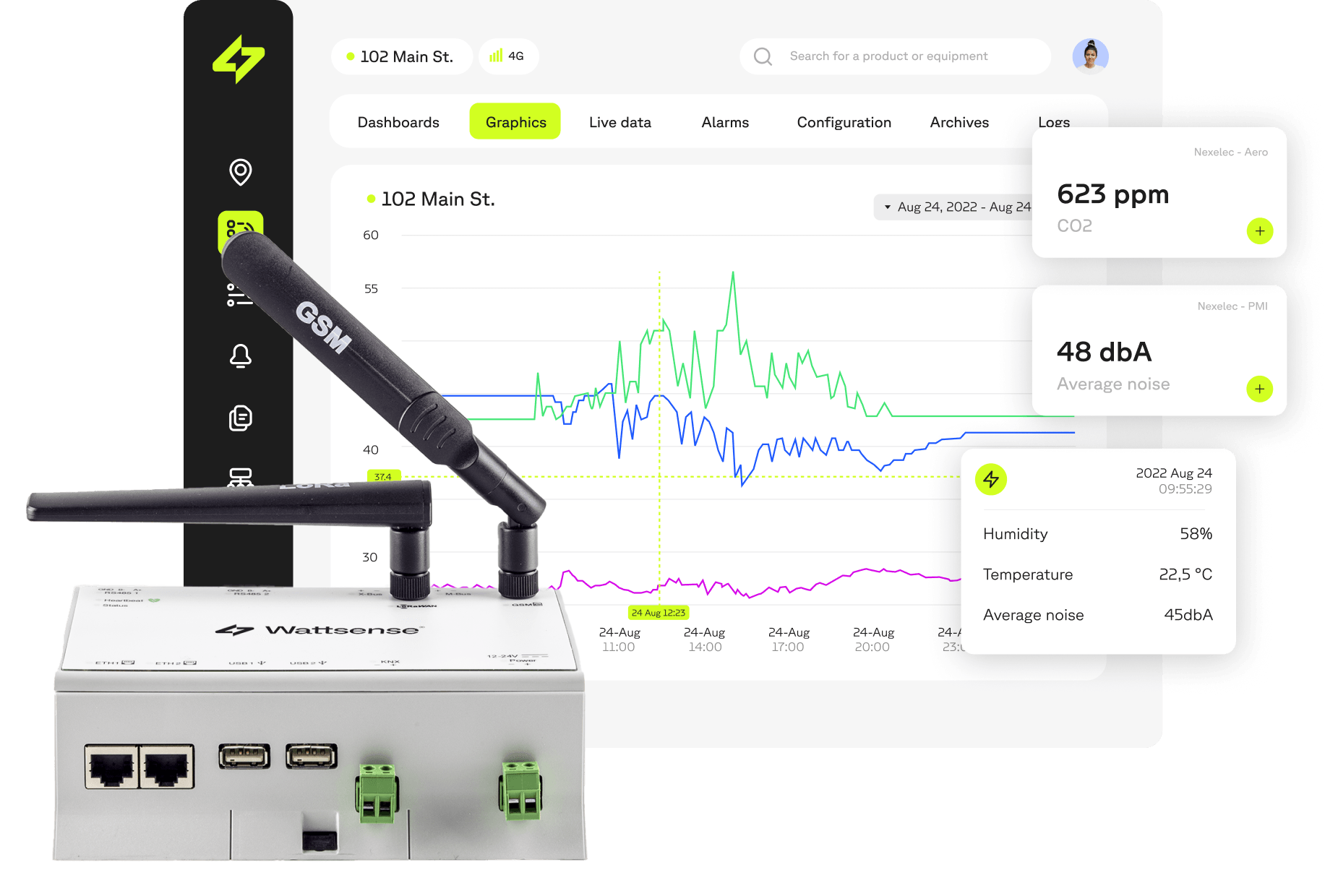
The Wattsense Bridge is the most innovative open, interoperable IoT gateway. It is designed for distributors and integrators focused on local data acquisition and on-site supervision. It acts as the foundational link between your building equipment and a BMS.
Key features include:
- Remote Configuration: Manage your gateway settings from anywhere.
- Real-time Data: Access immediate insights from your connected devices.
- Local Redirection: Easily integrate with BACnet, Modbus, or MQTT.
- Interoperable: Ideal for bridging LoRaWAN sensors to an existing local BMS.
Tower Lift: Cloud Connectivity for PropTech Data Collection
Tower Lift is our IoT solution designed for solving building connectivity issues. It focuses purely on efficient and secure data retrieval, providing powerful cloud connectivity for data-driven professionals and PropTech companies.
Main Features:
- Data Historisation: Store and access historical data for in-depth analysis.
- API & Webhook Integration: Seamlessly push data to your preferred cloud platforms.
- Use Case: Ideal for portfolios where the primary need is to collect vast amounts of data from meters and sensors via API for billing or predictive maintenance.
Tower Control: The Light BMS for Efficient Operations
Tower Control is our flagship offering, providing a "Light BMS" for small and medium-sized buildings. It is a complete automation solution that puts you in command of your building’s performance and operational insights.
Main features:
- Automation Scenarios: Create custom rules to optimize energy consumption.
- Scheduling: Implement time-based controls for HVAC and lighting.
- Remote Alarms: Receive instant notifications for critical maintenance events.
Dashboards: Visualize building performance with customizable insights through intuitive graphs.
Unlock Building Performance
The simple solution for intelligent, simplified technical and energy management of small and medium-sized buildings.