The Modbus protocol in building management



Modbus is a standard open communication protocol used to establish client-server communication between intelligent devices.
Modbus was created in 1979 by Modican for use with Programmable Logic Controllers (PLC). It uses a Master/Slave architecture where the device requesting the information is called the Modbus Master, and the devices supplying information are Modbus Slaves. The Master can also write information to the Slaves.
The Modbus protocol is one of the most used protocols in the building sector to transmit information from control devices to the central controller that can be used as a data-gathering system. Its uses are with Building Management Systems (BMS) and Industrial Automation Systems (IAS).
This protocol primarily uses RS-232 or RS-485 serial interfaces for communications; it connects a supervisory computer with a remote terminal unit (RTU) and data acquisition with SCADA software. These characteristics make it easy to integrate with building equipment and control applications.
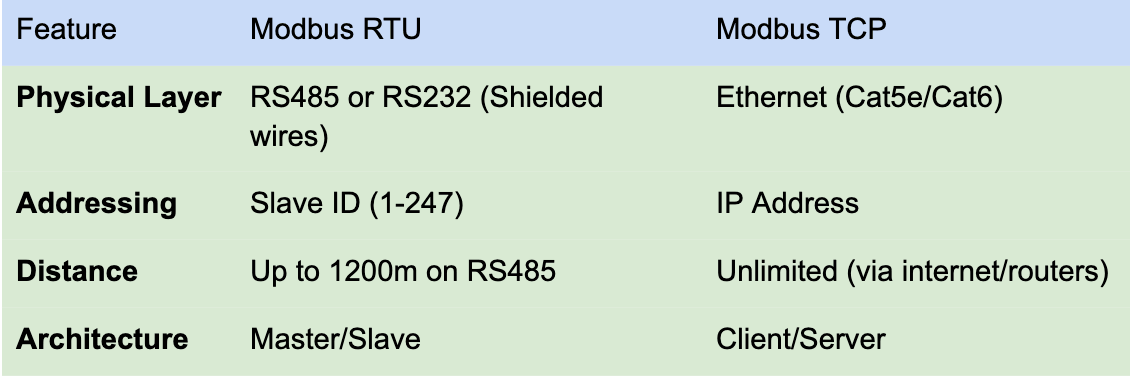
There is the Modbus RTU for serial lines, and for Ethernet connections, the Modbus TCP.
The advantage of Modbus in building management
- Open protocol, it avoids royalty payments for users.
- Simple to use.
- No need for RAM space. In the early days, this feature was key when processors used 8-bit technology, and RAM and ROM resources were more expensive and challenging to acquire.
- Message checking with low transmission errors and 99% accuracy.
Modbus TCP Server

The Modbus data communication protocol is one of the most commonly used protocols in the building management sector. It was initially developed for Programmable Logic Controllers (PLC).
Such as Modbus RTU or ASCII, Modbus TCP is a variant of the Modbus protocol. Modbus TCP is a communication protocol that allows two or more devices to communicate via an IP network. Unlike Modbus serial link, Modbus TCP is not based on a hierarchical structure but a client/server model.
Modbus TCP is an open Industrial IP network specified as an RFC Internet standard. It can also be known as Modbus TCP/IP.
The transfer of information between a Modbus client and server starts when:

- The client sends a request to the server to transfer data, execute a command, or perform one of many other possible functions.

2. After the server receives the request, it runs the command or recuperates the required data from its memory.

3. The server then answers the client by acknowledging that the command is complete or offering the requested data.
The Modbus TCP functionality implements both client and server services to initiate communications with other controllers and I/O devices and respond to requests from other controllers, SCADA, and other equipment or supervisory systems.
Without any configuration, the controller's embedded Ethernet port supports Modbus Server and does not require extra programming tactics from the user.
Modbus TCP to LoRaWAN functionality

Wattsense is an IoT solution dedicated to facilitating BMS integration and quickly connecting technical assets. We have developed the Bridge, an intuitive IoT gateway and powerful controller to simplify BMS integration.
The LoRaWAN to Modbus TCP function allows users to locally collect data on any sensor such as consumed electricity, water, gas, air quality, temperature, or even other building parameters which otherwise have to be checked separately.
The functionality centralizes information with a complete system overview displayed in our user-friendly console, or it can also be redirected to your preferred supervision system, such as SCADA.
The Wattsense LoRaWAN to Modbus functionality implements a Modbus TCP Server communication. Learn more about the LoRaWAN and Modbus functionality.
For more information about connecting your Modbus equipment with the Wattsense IoT, write us at: contact@wattsense.com
How Modbus works: The Client/Server (Master/Slave) Model
At its core, Modbus operates on a request-response mechanism. Historically, this was known as the Master/Slave model, though modern documentation often uses the terms Client/Server.
- The Master (Client) initiates a request.
- The Slave (Server) waits for a request directed at its unique address.
- The Slave processes the request and sends back a response or performs an action.
On a standard rs485 Modbus network, there is only one Master and up to 247 Slaves. This strictly controlled communication prevents "collisions" on the wire, ensuring that data collection remains reliable even in environments with significant electrical noise.
Other Modbus resources
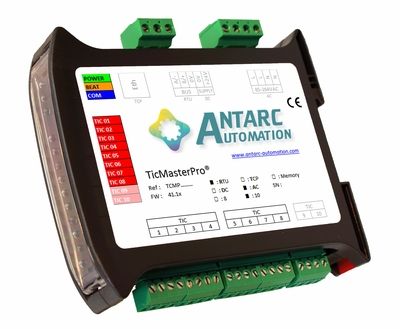
When building the appropriate set of parameters for Modbus configuration, an interesting device is the TicMaster Modbus teleinfo gatewayModbus teleinfo gateway by Antarc Automation.
The TicMaster® is an intelligent gateway for the acquisition of customer tele-information signals (TIC) broadcasted by Enedis electronic meters. It offers from 2 to 10 TIC inputs allowing it to follow simultaneously as many meters. It is compatible with all Blue (CBE), Linky, Yellow (CJE), Green (Emerald) (ICE), SME-SMI, and SAPHIR meters.
The commissioning is fully automatic and does not require any action from the user.
The integration in the IoT Box is immediate, thanks to predefined templates.
The host interface is either Modbus RTU or TCP.
How Wattsense Simplifies Modbus Connectivity
Wattsense provides a revolutionary technology to simplify building management. We remove the barriers to data collection, helping you improve building performance and cut operational costs. Our mission is to make integration effortless, whether you are dealing with modbus rtu or modbus tcp.
By acting as a universal translator, Wattsense allows you to centralise data from any Modbus device and redirect it to your preferred tools—whether that is an on-site BMS or a cloud analytics platform.
Universal Gateway: Connecting Modbus RTU/TCP to BMS or Cloud
The Wattsense solution is more than a simple modbus gateway. It is an open, interoperable platform. Our Configuration Wizard eliminates the need for manual register mapping. We maintain a huge library of pre-decoded Modbus devices. You simply select your device model, and Wattsense automatically maps all the registers for you.
This Plug & Play approach saves days of engineering time and eliminates the risk of manual data entry errors.
The Bridge: local Integration for Integrators
The Wattsense Bridge is our local gateway designed specifically for distributors and integrators. It is the perfect tool for local data acquisition and on-site supervision.
- Use case: You have several modbus rtu rs485 power meters and want to bring that data into a BACnet IP-based BMS.
- Solution: The Bridge connects to the meters, decodes the data, and redirects it locally as BACnet objects.
- Benefit: It acts as a reliable, local bridge for sensor data, enabling local automation based on real-time conditions.
Tower Lift: retrieving Modbus Data for PropTechs
Tower Lift is the IoT solution for solving building connectivity issues in residential or commercial portfolios. It provides powerful cloud connectivity for those who want to leverage data without needing direct automation from the hardware.
- Use case: A PropTech company needs to collect water and electricity meter data from 50 different buildings for a billing app.
- Solution: Tower Lift retrieves the data via Modbus, historises it, and pushes it to the cloud via API or Webhooks.
- Benefit: Massive data collection across thousands of points without the complexity of managing on-site servers.
Tower Control: automation for smaller buildings
Tower Control is our flagship offering—a "Light BMS" for small and medium-sized buildings. It provides a full suite of tools for monitoring, controlling, and optimizing performance.
- Use case: A facility manager wants to schedule a Modbus-controlled HVAC system and receive an alarm if the boiler pressure drops.
- Solution: Tower Control allows you to create automation scenarios, set time-based schedules, and receive remote alarms on your smartphone.
Benefit: You put yourself in command of your building, saving energy and preventing downtime with an easy-to-install solution.
Want to learn more about the Wattsense connectivity solution?
Discover our solutionContinue reading

The Professional LoRaWAN Gateway for Smart Building Connectivity